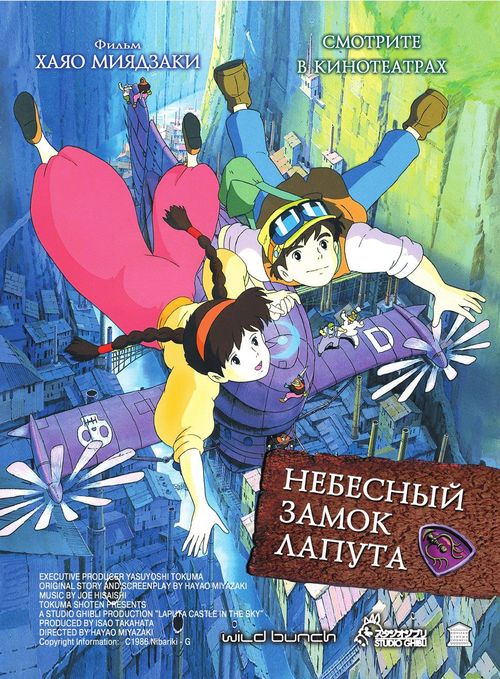
| Производство: | Япония174 |
|---|---|
| Премьера: | 02.08.19867 |
| В россии: | c 28.02.2008 |
| Жанр: | приключения111, сказка33, романтика30, паропанк1 |
| Тип: | Anime159, п/а18, 124 мин. |
| Режиссёр: | Миядзаки Хаяо22 |
| Автор оригинала: | Миядзаки Хаяо22 |
| Студия: | Ghibli16 |
| Видео: | DVDRip Xvid AVI |
| Аудио: | Rus , Rus (ext), JAP (ext)+SUB |
Описание
Альтернативная реальность, находящаяся на уровне технического развития Европы начала XX века (дизельпанк). Лапута, легендарный летающий остров, для одних является сосредоточением огромной военной мощи, для других — несметных сокровищ. Но небесный замок, затерявшийся среди облаков, возможно найти лишь с помощью кристалла Летающего Камня. Юная Сита, носившая талисман, который являлся для неё лишь семейной реликвией, не подозревала об этом, пока за ней и её кристаллом не началась охота. Фильм начинается с нападения воздушных пиратов на дирижабль. Сита срывается и падает вниз, однако волшебная сила талисмана спасает её. Ситу в бессознательном состоянии находит мальчик Пазу из шахтёрского городка. Однако пираты не оставляют надежд завладеть талисманом. Их конкурентами являются военные, которые с помощью талисмана пытаются найти путь на летающий остров Лапута, скрытый в облаках воздушного океана. Военные захватывают Ситу в плен. Талисман случайно возвращает к жизни ужасного боевого робота, и Сита с помощью Пазу бежит из крепости. У военных остается талисман, который ведет их дирижабль «Голиаф» к Лапуте. Их преследуют пираты, на сторону которых встают Пазу и Сита. Во главе военных оказывается Муска — один из потомков властителей Лапуты (дальний родственник Ситы), который мечтает с помощью талисмана и острова завладеть миром.


Ultimately, the Kiss and Cry is a metaphor for the pursuit of excellence. It serves as a reminder that every great endeavor concludes with a moment of reckoning. By televising these seconds of anticipation, figure skating honors the emotional weight of the journey, proving that the reaction to the score is often just as compelling as the performance that earned it.
This stillness strips away the performer's mask. The cameras zoom in, capturing the raw, unedited spectrum of human emotion: the euphoric "kiss" of a personal best or the devastating "cry" of a missed podium. It is a rare space where the boundary between the private athlete and the public persona completely dissolves. The Partnership on Display
The Kiss and Cry is unique in professional sports because it forces a moment of extreme intimacy onto a global stage. In most athletic arenas, the transition from action to result happens in motion. In figure skating, the "action" is a four-minute whirlwind of physical exertion and artistic storytelling, but the "result" is delivered while the athlete sits perfectly still, often gasping for air.
Beyond the athlete, the Kiss and Cry illuminates the complex relationship between skater and coach. For years, these pairs work in relative isolation, grinding through injuries and technical plateaus. In the Kiss and Cry, the coach transforms from a stern technician into a source of emotional scaffolding. Whether it is a hand on a shoulder or a shared celebratory leap, this space highlights the communal nature of what is ostensibly an individual sport. The Narrative Power
From a spectator's perspective, the Kiss and Cry is where the "story" of a competition is written. It provides the "why" behind the performance. When an underdog sees a score that guarantees a medal, or a favorite realizes their dream has slipped away, the audience connects with the humanity of the athlete more than they ever could during a triple axel. It humanizes the superhuman, reminding viewers that beneath the sequins and the speed is a person vulnerable to disappointment and capable of immense joy. Conclusion